Showing posts with label Video Games. Show all posts

Friday, March 08, 2013

'Of Games and God': A Review

My "Gift from Author" version
sitting on my counter the day
 it arrived in the mail!

Full disclosure: Kevin Schut, Ph.D is the author of ‘Of Games and God: A Christian Exploration of Video Games’. He is the chair of the Department of Media and Communications at Trinity Western University in Langley, Canada. Before getting his Ph.D at the University of Iowa, he and his wife served as missionary teachers in Africa and Eastern Europe, where I met them. His AP Modern European History class is what taught me how to write (now you know who to blame!) Before publishing this book he asked me to read and give feedback, which I did gladly and, I'm sure, inadequately.

The plight of the nerd has improved considerably in the last few years. While it was previously frowned upon for an adult such as myself to openly display their love for Star Wars, this is no longer the case. Sci-fi has infiltrated mainstream culture to an incredible extent. Shows like ‘Chuck’ and ‘Big Bang Theory’, popular comic book movies like the ‘Dark Knight Trilogy’ or ‘The Avengers’, and the sleek, lens-flaring ‘Star Trek’ reboot have not only taken the taboo out of being a nerd, they’ve thrust nerds to the forefront. I never in my wildest dreams thought that I would hear the term “adorkable” used, and I certainly never thought such a term would be used endearingly and as a compliment!

Real life nerds, in their native
habitat (Star Wars: In concert)
The real-life “Revenge of the Nerds” is going swimmingly, but it is still very much a work in progress. While sci-fi TV, movies, and literature have garnered respect, or at least acceptance, in the main stream, the realm of video games has lagged slightly behind. Despite generating revenue equal to or surpassing the music and movie industries, gamers have remained a niche sub-culture. Where sci-fi lovers and avid comic book readers have been allowed to start reading their books out in the open, we gamers are still relegated to our mother’s basements (Disclaimer: I do not, and have never lived with my parents since leaving for college: I live with one of my college roommate’s parents instead! But on the ground floor, mind you!).

The sub-species of Christian gamers have been scorned even more. Not only are we looked down upon by society as social outcasts for being gamers, but we very often have the judgment of our Christian brethren beating down on us as well. We’re not just anti-social, we are misallocating our skills as Christians by “wasting our time” playing “meaningless” games. While my gaming activities may not be sin (it depends on who you ask), they are often addressed by Christian leadership with the sort of tone that would usually be reserved for a disappointing relative. But are the identities of being a gamer and a Christian mutually exclusive? Do they really have to be at odds with one another?

‘Of Games and God’ is for any Christian gamer who has ever felt ashamed to admit their love of video games in front of other Christians. It is also for every Christian who has proclaimed gaming as a waste of time. At the same time, there is something in this book for the unabashed gamer who has never really taken the time to consider the pitfalls of the platform. The activities we allow to fill our time, as Christians, are something we are responsible for, and therefore they must be analyzed from time to time. But there is room in the Christian worldview for joy, for play, and for fun. To write off all games as a waste of time would be a missed opportunity for exploration, creativity, education, and, yes, even social interaction. To me the question isn’t so much  “Should Christians even play video games at all?”, but rather, “Can the Church afford to ignore and shun the segment of the world that does?”.
Look closely and you'll see
my name in the acknowledgments.
Probably as close as I'll ever
get to being published!

Schut does a brilliant job of explaining that games are really just another media platform. Just like radio, television, newspapers, the Internet, or even books (real books, not just comic books!), games are a form of media that provides both information and entertainment. They just happen to be newer and more varied than the other platforms I just mentioned (with the exception of the Internet). That newness, along with the extremely wide range of game types, often scares people. But like any form of media, they are not innately evil: neither are they innately good. While he will defend the merits of gaming, Schut doesn't naively ignore its faults. Most people fall into one of two camps: they immediately think no good can come of gaming, or they don’t care about the moral implications at all. Christian gamers, and Christians in general, have to think beyond that.

Throughout the course of 'Of Games and God' Schut makes references that will make long-time gamers giddy with joyful memories, but he also does an excellent job of explaining things to the uninitiated. This makes the topics at hand approachable for both sides. Refreshingly, Schut also doesn’t presume to have all the answers. What he does, chapter by chapter, is present a variety of topics that Christians and Christian gamers should think about. That isn’t to say he lacks any opinion whatsoever: he just chooses to expend his energy trying to facilitate proper evaluation and discussion of what games are, what they should be, and what we have to be careful about letting them become. 

Maybe you will consider it an added bonus that I can confirm that Schut himself is for real. He's an actual living, breathing adult video game player who also happens to be a thoughtful Christian: not just some stuffy academician trying to sell a book (that being said... buy his book!). Whether it's the explanations of "the magic circle", the exploration of the values of gaming community, or the analysis of the merits and perils of fantasy and escapism, 'Of Games and God' will challenge you to think about topics you never considered and reconsider topics you had previously dismissed. Like and good game, Schut motivates us readers with a challenge: the challenge is to consider new ideas and refine your preconceived notions about the values an pitfalls of video games. While there are no achievement points or trophies to be earned for completion, it is a challenge worth accepting. 

Saturday, December 15, 2012

So Long, Nintendo Power; Let's Pick Apart Your Top 25 List

Well it has been awhile, but I had to comment on Nintendo Power's list of the top twenty-five video games of all time (actually, I already did in response to an email, making this an easy post to write...).  Also, you just watch - blogging is going to become cool again as social media sites chase people away with increasing ads and constantly changing privacy settings, only now people are used to being able to make inane observations about everything publicly!

There actually could be a bit of a comeback in store - I won't promise anything, but you could see three, maybe even four, new posts on this site in 2013!

Anyway, my friend and frequent commenter Rob Malas emailed me the top-25 as well as a list of his most notable omissions.  I'll give y'all the list, then my comments on the ones that I have played.  Not surprisingly, this only includes games released on Ninetendo consoles:

Nintendo Power's Top 25:
25 - The Legend of Zelda: Link's Awakening DX
24 - Mario & Luigi: Superstar Saga
23 - Castlevania: Dawn of Sorrow
22 - Super Mario Bros. 2
21 - Street Fighter 2 Turbo: Hyper Fighting
20 - Paper Mario: The Thousand Year Door
19 - Chrono Trigger
18 - Super Mario 3D Land
17 - Metroid Prime
16 - Super Mario Bros.
15 - Super Mario Galaxy 2
14 - Super Mario 64
13 - Elite Beats Agents
12 - The Legend of Zelda
11 - The Legend of Zelda: Skyward Sword
10 - Resident Evil 4
9 - The Legend of Zelda: The Wind Waker
8 - Super Metroid
7 - Super Mario Bros. 3
6 - Mega Man 2
5 - Super Mario World
4 - Final Fantasy III (VI in Japan)
3 - Super Mario Galaxy
2 - The Legend of Zelda: A Link to the Past
1 - The Legend of Zelda: Ocarina of Time

Notable titles missing from the top 25:
27 - SUPER CASTLEVANIA IV
33 - THE LEGEND OF ZELDA: TWILIGHT PRINCESS
39 - MEGA MAN X
79 - GOLDENEYE 007 (N64 - ONLY 79?)
128 - SUPER MARIO RPG
141 - ANIMAL CROSSING
161 - SUPER MARIO KART
212 - STAR FOX
213 - TMNT II: THE ARCADE GAME
256 - F-ZERO
261 - SUPER MARIO LAND 2: 6 GOLDEN COINS
272 - DONKEY KONG COUNTRY
285 - SUPER STAR WARS

 Here's my take, first for the top 25:
25 - Link's Awakening:
 I only played the GameBoy version, but even squinting at that dim, black-and-white screen, this was a good one.  #25 sounds about right.

22 - SMB2: 

Underappreciated game, but I think 22 is a little too high for what was essentially an experiment in changing SMB that didn't work.  Even Nintendo agrees with me as I think the Bob-omb was the only thing from SMB2 that shows up later in the series (although since it is a dream, that may be for continuity reasons?).  Laid the groundwork for Halo 2 as a video game sequel that had some cool ideas but tried to change too much about a great original game.  If Mario 2 is on this list, Zelda 2 should be also.  One thing I take away from this list is that Nintendo Power loves them some Mario series.

21 - SF2 Turbo Whatever it Was:
I have to admit, I was more of a Mortal Combat fan.  Top-fifty for sure, top twenty-five is questionable.  Started an amusing trend of arcade games and their console versions keeping the same number and adding some adjectives when they made a sequel.

19 - Chrono Trigger:
Chrono Trigger is a GREAT game, and kind of makes me want to figure out how to set up an emulator.  I replayed this game at least three times, and it was a pretty long one (you had to play it at least twice so you could have Magnus on your side once and kill him once).  Other than the "combo" attacks, I'm not sure that it changed RPG gameplay all that much, but the plot was terrific - complex enough to be interesting, simple enough that you could follow it even if you weren't a D&D nerd, and in one game it showed you the whole history of an interesting fictional world.  (SPOILER: also, even though you go back and avert it, the main character dies, and the first time, he usually does so with all of your sweetest gear!  I can't think of many video games with legitimate jaw-dropping plot moments like that one END SPOILER).

16 - SMB1:

Tough to rank since video games have gone way beyond it since, but it is actually still semi-playable even now and it might be the most influential video game ever.  When you think about it, probably about 80% of the games released for the 8-bit Nintendo, and a lot of SNES and Sega Games too, used the side-scroller format established by this game.  Somehow, Duck Hunt did not have nearly the same influence.  16 is a little low for for my taste, but they're right not to have it in the top ten.

I refuse to believe that anything called "Elite Beats Agents" deserves to be ranked that high (then again, "Animal Crossing" is an equally uninspiring title and one of Rob's friends swears it is the best game ever).

12 - The Legend of Zelda:
Great game, could be higher, plus, they invented the "open world" game twenty years before it became a trend (In my opinion, an annoying trend.  I can see how kids may like them because they live a fairly linear life, but once you get done with college, if you want to not know what you are supposed to do next, you have real life.  You don't need that from your entertainment.)  Anyway, past dungeon 3, they do not give you a road map for this one at all, plus the dungeons are tough once you finally find them.  Beating this game is one of kid me's more impressive achievements (seriously); I don't know how I did it.  Actually the fact that I'd never try to play through this again probably means the ranking is about right.

10 - Resident Evil 4:
Yes, yes, yes.  Manages the horror atmosphere so well that I was terrified WATCHING one of my friends play this game.  Salazar and his vaguely napoleon-ish henchmen might be my two favorite "one episode" villains in video games.  My one complaint is that the controls on the Gamecube version were horrid (not really that game's fault; that controller just wasn't designed for shooters), but it played beautifully on the Wii and I'd be fine with that version being in the top five.  I guess the Gamecube version fans could argue that it adds to the horror when you need to look down at the controller to figure out how to reload while a guy with a chainsaw and a bag over his head is bearing down on you.

9 - Zelda Windwaker: 
 I didn't play this but watched Mac play through at least 75% of it in college and I was kind of unimpressed.  Nothing ever looked that challenging (then again, Mac was, at the time, one of America's foremost experts on the Legend of Zelda), and it seemed like you spent more time going across the open ocean with nothing happening than doing anything else.  It did have a unique feel that worked, but that alone doesn't put it in the top ten for me.  I could be being harsh on a game that I never played myself though.  I'd be interested to see Lew's rankings for which video games are the most fun to watch other people play.

7 - SMB3:
#1 for me at least among Nintendo games.  It's mind-blowing given the graphics and complexity that this came out for the regular old 8-bit Nintendo.  The most common way to play through it now is to use the Warp Whistles and only play Worlds 1, a little bit of 2 and 5, and 8, but if you play through the whole thing, it's both really challenging (ok, it kind of needed a save mode or at least some kind of password system), and each world has a totally unique feel.  A mind-blowing game at the time (Mario World was also mind-blowing, but it was a console launch game and therefore it was expected to be).  Plus, think of the stakes: coming off a sequel a lot of people didn't like, had this game bob-ombed, the Mario series might have been done!  Pulls off what Metallica's "Death Magnetic" album in that it was both a return to Mario's roots and more complex than anything they'd ever done (SMB3 was better though).

6 - Mega Man 2:
There should be a Mega Man game near the top, but honestly every Mega Man game I played felt totally indistinguishable from all of the other Mega Man games, even across console generations.  Maybe they could just treat the "Mega Man Series" as a fifteen-parter and give it spot #5?

5 - Mario World:

This is about right.  SMB3 deserves to be above it because really, other than Yoshi, what else new did this game bring to the series?  (The cape was the same as the leaf; you're not fooling me Nintendo!)  That said, the hidden world and the ability to change the look of every normal level by playing through it was, well, "tubular" and "gnarly."

2 - A Link to the Past:
This would be my #2 after SMB3.  What a great game.  Like SMB3, every dungeon and even every region of both outerworlds had a different feel, and like SMB3 it redeemed an iffy experimental sequel by returning to, and improving on, its roots.  Probably the first video game that really felt like an epic adventure.  Also, it introduced BOING! the best ranged weapon BOING! in the Zelda series (and one of the best in any game), the hookshot!

1 - Ocarina of Time:
Personally I thought a Link to the Past was a little more fun, and I thought the Dark World/Light World concept was more interesting than time travel over such a brief period.  Actually, if you consider Navi as Al, maybe this game was loosely based on Quantum Leap?  Ok, probably not.  Still, this passes the "mind blowing when it came out" test more easily than anything on the list, and while I haven't played it recently, I'd bet it holds up pretty well now.  Also, it influenced pretty much every third person adventure game that was made after it, even up to the present day, so there's that.  While I would probably have it merely in the top five, this is definitely a defensible #1 pick.

And now, to the omissions:

27: Super Castlevania IV
I absolutely loved this game and I think the ranking is about right.  It seems like an obvious move now, but being able to whip things diagonally was huge at the time.  This is another game that I replayed multiple times.  I always get charged up at the beginning of the last level when it brings back the Castlevania I music.

39 - Mega Man X:
This is actually my favorite of all of the Mega Man games that I can't tell apart.

79 - Goldeneye:

Had this been ranked a year after it came out I think it makes the top twenty.  It really suffers from the fact that it was the last big console shooter prior to Halo, which totally altered the standards for video game shooters.  I went back to Goldeneye once after college, and after being used to smooth-handling shooters with multiple vehicles and dozens of weapons to choose from it felt like an unplayable mess.  Which is sad, because other than Halo and Madden I'm not sure if there was ever a game that was so universally played and liked by everyone for a few years.  There was no point to have an N64 if you didn't have Goldeneye.  Unfortunately, I'm not sure if there's a game that was enjoyable at the time that has held up worse over the years.

128 - Super Mario RPG:
I actually think this was a Mario experiment that worked.  I was going to express surprise given the franchises' track record that this didn't spawn a huge Mario RPG series, but a quick Wikipedia search reveals that, oops, it did!  Maybe I should try to play those other ones...

161 - Mario Kart:
"Double Dash" is the best version of Mario Kart and should be in the top 25.  For that matter, Mario Kart should be in the top 100.

212 - Star Fox:
Way too low.  Quick, name another airplane/spaceship fighting game that was actually fun to play.

213 - TMNT II:
I played this a lot but it was a little too simple to deserve to be ranked that much higher (it shouldn't be ahead of Star Fox, anyway, although I'm sure it should be ahead of "Luigi's Cookbook" or whatever else is stuck in the top 200).  I'm curious about how the first TMNT game is ranked.  Did they penalize it based on the fact that nobody has ever beaten that game?

256 - F-Zero:
 I'm fine with the low ranking if only because making a racing game without any multiplayer mode is just unconscionable.

272 - DK Country:

Way too low; this should be in the top fifty.  This was the Super Nintendo's version of SMB3, you look at it and think "isn't that an N64 game?"  Plus, unlike Mario and Luigi, Donkey and Diddy required totally different playing styles.

285 - Super Star Wars:
Consensus among my friends seems to that this was an incredibly difficult game; if it actually is the one I'm thinking of, I honestly didn't think it was that tough.  I guess I'm some kind of Super Star Wars Savant.  Before y'all think I'm not humble or something, I will point out that as life skills go, that isn't very useful; it isn't even a game that you can beat your friends at or anything.

Ok, that's it for now.  This did get me thinking that it would be fun to put my own top-25 list of video games together, especially to see where non-Nintendo games like Diablo II and Halo would fit in.  Perhaps that will be one of my next posts here.  Look for it coming soon, in early 2014!

Monday, April 21, 2008

Is Anyone Still There?


Does anyone else realize that we have 3 straight posts about video games? I know that the last entry was dated in October, which means it only took me 6 months to figure that out, but that is still unacceptable. I may have to announce my 2nd comeback again (a la MJ with the Wizards) so we can get back to our first love of sports. If we can get 3 legit comments to this post, I'll write about my Masters' experience with Yates. There are some funny stories that I still haven not told about that weekend. If that goes well (big if), I may even find the urge to write about my beloved Hawks in the playoffs for the first time in 9 years, my hopeful plans for the Falcons to draft Glenn Dorsey with the 3rd overall pick this Saturday, and why I feel the Braves are at a crossroads during this season. So get excited (or if you know me, expect this little update to be my last post for the next six months)...

Sunday, October 07, 2007

A "Master"ful Performance?

In an effort to bring something new to the Village Tavern, we're actually going to make an attempt at reviewing something that came out recently. Anyway, here's my review of Halo 3.

Story: C-

Despite some rumors to the contrary, Halo 3 picks up pretty closely to where Halo 2's (drastically disappointing) ending left off. The game begins with the Master Chief bailing out of the forerunner ship that he was (apparently) on and crashing on Earth, conveniently near a party of marines. The story from then on is pretty similar to the Master Chief portion of the Halo 2 story – you fight your way through the Covenant on Earth (in this case Africa) for a little while, and then eventually end up on a forerunner installation trying to cause some giant explosions and prevent others. That's a little bit of a simplified version – in actuality, the depth of the story is somewhere between those of the first two games. While this game doesn't have a bad story, there were a few things I didn't like about it:

- A lot of the scenarios, and in some cases even level layouts, are really, really similar to stuff that happened in the other two games.

- The arbiter follows the Master Chief along throughout the campaign, and while it's kind of fun to see both fighting alongside each other, it essentially eliminates the arbiter's storyline, which was the most interesting aspect of Halo 2's story. Remember how the story for The Lord of the Rings was entertaining when the characters were all traveling together, but then got really interesting once Tolkein split them up? This is kind of the complete opposite of that.

- I'm not a huge fan of boss battles in shooters as a general rule, but they did a pretty good job with them in Halo 2, and the problem here is that a lot of this game's story seems to be building towards epic boss battles with Gravemind and the Prophet of Truth, neither of which actually end up so much happening. Seriously, how do you kill off the two primary villains in a video game without a boss battle? It's unheard of. I should mention that there is at least a battle with 343 Guilty Spark (the Monitor), which is nice since everyone who plays these games has wanted to kill that thing since 2/3rds of the way through the first game.

- Although the ending is not nearly as bad as the end of Halo 2, it's still a minor letdown, not to mention the fact that the final scene is a little bit confusing, both in regard to what actually happened and how.

Gameplay: A

This was probably both one of the biggest strengths of Halo and Halo 2's most severe weakness, so considering those facts, and the fact that this is what I consider the most important aspect, this is obviously the make-or-break point for this game. Well, I'm happy to report that it's mostly good news. In Halo, the Master Chief was quick and agile, much like Mike Williams at USC. Once Halo 2 started, it looked like the Chief had taken a year off and then trained with the Lions. You have to play the games back-to-back for it to be very noticeable, but the walk speed was substantially reduced in the second game for no apparent reason. While it doesn't seem like a big thing, it not only makes it take longer to walk to an objective in a level or multiplayer game, but also reduces the extent to which dodging and strategic movement is helpful, and basically makes the game a lot less fun. And while I'm not sure if the Chief is as fast in Halo 3 as he was in the first game, he's definitely quicker than in Halo 2.

Another significant improvement is the weaponry available, both in the quality/quantity of weapons available and in the weapon balance. While Halo 2 introduced dual wielding, they attempted to compensate for this by making every dual wielding weapon weak and useless as a stand-alone gun. This took a lot of the fun out of the multiplayer games in Halo 2, since in order to be successful you had to spend as much time looking for weapons and items as you did hunting down the other players. While I haven't played the multiplayer game a lot in Halo 3 yet, the only really useless gun in the game is the plasma pistol, and even that's more of a situational weapon than it is truly useless. The end result is a game which includes all of the added wrinkles from Halo 2, such as dual wielding, vehicle boarding, and melee weapons, but has fixed the major flaws from that game. So basically, you have the game that Halo 2 should have been.

Improvement Over Previous Games in Series/Genre: B+

This game doesn't do anything new that's Earth-shattering (beyond fixing the issues from Halo 2 mentioned earlier), but there are some nice new wrinkles:

- Several new weapons, including a machine gun that shoots spikes, mini-shotguns that can be dual wielded (weld?), and the hammer that Tartarus had at the end of the second game, which is called the “Gravity Hammer,” which is a little bit of a strange name since I thought that was how every hammer worked.

- You can pick up the turrets and walk around with them, although you move at Halo 2 speeds when you do. There are also a couple of other heavy weapons that work this way, like a missile launcher and a flamethrower. Which is always a nice touch.

- A few new vehicles, although with the exception of the Hornet (which is basically a helicopter), most of them aren't that great; the Ghost, Scorpion Tank, and Banshee are still the most fun vehicles in the game to use by a pretty good margin.

-There are now four kinds of grenades, including a fire grenade and a spike grenade, although this was probably the one addition I didn't really like, since you now can only carry 2 of each kind, and I honestly would rather just have more frag and plasma grenades.

- You now can pick up items, like deployable shields and active camo, and use them at strategic times during the game. While I don't think I've really figured out how to take full advantage of most of these, it's a very nice touch.

Graphics: A

While the graphics in this game don't blow everything else out of the water like the first Halo game did, it does look better from a real standpoint than either of the first two and, honestly, almost everything else that I've played. The Brutes actually now look vicious and more resemble the ancient vampire from season seven of Buffy the Vampire Slayer than they do evil care bears or ewoks on steroids. I actually saw them and thought, “oh, THAT'S what those were supposed to look like." The flood also has been revamped and are basically a whole lot creepier. Between that and the fact that Cortana and Gravemind occasionally appear in hallucinations throughout the levels, the game seems to be going for more of a Resident Evil/horror movie type of feel. Watching someone play one of those games gave you the feeling that you were watching a great horror movie (which is the exact feeling you don't get while watching the Resident Evil movies) and although Halo 3 never really manages to do that, this is more because it's a space fantasy than because of any problems with the graphics.

Replayabilityness: Incomplete (tentatively C-)

Officially I'm giving this an “incomplete” since it's not really possible to judge how well a game that I've had for two weeks will hold up. But there are a few reasons that I'm not all that optimistic. The campaign is too short – I finished it on heroic the first time in about ten hours over two days, and for that matter I don't remember using the banshee or the rocket launcher even one time during that, which was a little bit of a downer. The other glaring flaw is that it was widely reported/advertised that this was finally going to be the shooter that had a four person co-op mode, and it most certainly does not, or more accurately, it only has this feature online, which is stupid, unnecessary, and completely defeats the purpose. I suppose it's better than nothing, and it will hopefully pave the way for other games that will do this (even though other genres have been doing it for a long time and it should have happened at least five years ago), but it still stands that Bungie had a chance to make possibly the most replayable game ever, and they dropped the ball by not including this feature as a split-screen option. In some ways, they fell into Microsoft's typical approach to customers, which is:

Step 1: Imagine who your ideal client/customer would be.
Step 2: Force as many people as possible into that mold by making sure that it's completely necessary in order to take full advantage of any products you make.

The thing is, I sometimes get the impression that Microsoft (and Sony, for that matter) are trying to kill split-screen gaming in favor of online action, which of course enables them to collect activation and subscription fees on a regular basis. And while it's nice to have that as an option, the fact of the matter is, people who don't mind paying monthly fees for their gaming, not being able to talk trash to someone's face that you're playing against, and spending the majority of your time playing against 12-to-15 year-olds that treat gaming as a full-time job are not big console gamers; these kind of people mostly play PC games. Console gamers for the most part are either kids or more casual gamers who don't really have the need, desire, or even ability to be a big part of an “online community.” Anyway, that's it for the soap box about that...and I will mention that I haven't played the multiplayer game – online or otherwise - very much, so if the multiplayer game is really good (and it seems like that's what they put more of their time into) and the game holds up well over time, this could easily move up to a B or even an A-.

Overall: B+

This is a good game, but I was hoping it would be better, and for various reasons (not all of which have to do with the game), I'd be surprised if I get nearly as into this one as I did Halo, or even Halo 2. I think the legacy of the Halo trilogy could be similar to that of the Matrix trilogy – an awesome, generation-defining first chapter followed by two sequels which were actually pretty good, but didn't quite live up to the promise of the original.


And now, so we can review TWO things that came out within the last two weeks (for the first time ever on the Village Tavern)....

Foo Fighters - Echoes, Silence, Patience, and Grace: A

Unsurprisingly, this album includes a mix of numerous hard rock songs, poppy, radio friendly songs, and a couple of nice acoustic numbers, in other words, everything you would expect from a Foo Fighters album at this stage in their career. What is a surprise, and a good one, is that it also includes a lot of things you wouldn't expect from a Foo Fighters album. While it's well-known at this point that Dave Grohl is a great drummer and songwriter, he's also become a very good guitar player and is starting to show it, with some legitimate guitar solos on a lot of the songs and an acoustic instrumental. They also mix their acoustic sound with hard rock on several songs, which I don't really remember them ever doing in the past. While there's some cases where they fall into the “play a nice acoustic song for a couple of minutes, then play something similar but rock it out” style of songwriting, there are also some cases (like “Let it Die”) where they're already doing this brilliantly. They've also gone to a much more classic rock sound, and while the influence of the grunge scene Grohl helped to develop isn't completely gone, this is an album that sounds more like Neil Young or Led Zeppelin than Nirvana or Pearl Jam, which in this case is a good thing.

Wednesday, August 22, 2007

16 Brothers I'd Like to Smash

Since the VT is on the subject of video games for the moment, I figured now would be the time to write an article about one of my favorite games from the last line of consoles – specifically, Super Smash Brothers Melee. What made this game so great was that it finally provided an opportunity to prove, once and for all, who amongst your friends really was the best at the old-school, platform-jumping games, which had previously not been provided (with the notable exception of the extra head-to-head game in Mario Bros. 3).

The only real gripe with the game to this point is the characters that have been chosen – not that they lack balance or don't allow for different playing styles, but they leave out too many of the iconic heroes of video game lore, while including characters like Young Link, NES, Captain Falcon, Falco, those two Japanese guys with swords nobody had ever heard of, and about sixteen characters from Pokemon.

Fortunately, the Village Tavern is here to help. Here's my top 16 video games characters that haven't appeared in Smash Bros. yet and should...

16.Worm
Series:
Worms

While these brave and creative little worm warriors might even be second to Earthworm Jim or (“Puta Earthworm James”) as the most famous video game worms, but after their games took up a solid portion of my freshman year, I'd be more than willing to see a worm running around with the Ninja Rope, Parachute, Bazooka, and Holy Hand Grenade, and I'd be even more excited to pick up mad cows, a Super Banana Bomb, or Concrete Donkey at the end of a close Smash Bros. game.

15. Diablo
Series:
Diablo

As my friend Noho was once fond of saying: “Make no mistake: Diablo is a badass.” And while he probably wouldn't be that different from Bowser, he could provide a faster “heavyweight” character, and it would be an excuse to include a Chaos Sanctuary level where a horde of minions came and wiped everyone out every time someone stepped on a seal.

14. Wario
Series:
Mario Brothers

Wario has long been one of the more mysterious characters in the Mario Brothers Universe. Wario sometimes appears as a villain and sometimes as a pseudo-hero, and it's unclear whether he's somehow related to Mario and Luigi, if him and Walugi are the Mario Brothers from the backwards Bizzaro World, or if they are the result of a failed cloning experiment by Bowser's scientist kid (at least I think one of the Koopalings was supposed to be a scientist). Anyway, Wario's the only one on this list that I can confirm actually will be in the new Smash Brothers Game, so I'll throw out the idea of having him drive around his Mario Kart in the game...this would make him a different character, as opposed to a slower and stronger version of his alter-ego/stepbrother/original form Mario. I also think a case could be made that the MarioKart spinoff has become an iconic series in its own right on the level of anything but the original SMB series and Zelda, so it should be represented. At the very least, I think the Lightning Bolt and Lead Killer could be incorporated as weapons.

13. Donatello
Series:
TMNT

What was great about the Ninja Turtles was that each one had something going for them: Leonardo was the de facto leader and could be considered the “main character” to the extent the series had one, Raphael was the most nuanced and interesting as a character, and Michaelangelo got most of the funny lines. While Donatello's “inventor” gimmick was kind of lame, his true strength was that he was the Turtle that dominated every TMNT video game ever made. This is primarily because his weapon was so much longer than those of the other Ninja Turtles...

12. Shang Tsung
Series:
Mortal Kombat

Ok, Shang Tsung's actual powers were a little bit lame, but it would be nice to see the MK series represented, and it's also a fun idea to have a guy in there who could morph into some of the other characters. That, and I would enjoy watching Pikachu getting his spine ripped out.

11. Ryu
Series:
Ninja Gaiden

While the 8-bit Ninja Gaiden games may not be among the first old Nintendo games you'd rush to go back and play, they definitely had their following. The series has enjoyed a renaissance in recent years thanks to Ninja Gaiden and Ninja Gaiden Black for the Xbox and Ninja Gaiden Sigma for the PS3 (all of which, by the way, are more or less the same game). I could imagine a character modeled after the more recent version of Ryu being tons of fun to play, especially if one remembers that the purpose of the Ninja is to flip out and kill people...

10. Falling Blocks
Series:
Tetris

Ok, I admit that this one is way off the beaten path, but honestly if there's one video game series that you can play for hours on end with darn near anybody, it's Tetris, and I think it would be fun to try and crush the other players with falling Tetris blocks. You could go a few different directions with this one, too – there could just be an item where you drop Tetris garbage on your enemies, or you could get smashed when your blocks get knocked up to the top, or the blocks could morph into some block-man juggernaut once you create a gold square. I might think about this a little too much.

9. Sam Fisher
Series:
Splinter Cell

I suppose I'm kind of getting my wish with this one, since Snake (from Metal Gear) is being included in the new game, and he and Sam are essentially the same person at different stages in their careers. Still, Sam possessed a nice array of close-range attacks, and could shoot sticky shockers and sleeping gas cameras all over the place, so I think this would work.

8. Diddy Kong
Series:
Donkey Kong Country (among others)

DK's answer to “mini-me” has, for reasons unknown, so far been uninvited to the Smash Brothers Party. I mean sure, last time he was around the rug got some nasty stains and we had to reupholster the couch, but what do you expect, he's a monkey? And besides, if you're going to have Mario and Luigi or Link and Young Link, doesn't it make sense to have Donkey and Diddy, especially considering that there actually were some differences between those two?

7. Master Hand
Series:
Smash Brothers

It would be weird to control, and I can't say I miss the ability to use it a ton, but seriously, in what other fighting game can you not play with the end boss after you've beaten it on single player mode?

6. Blanka
Series:
Street Fighter

Like most people, I was first exposed to the one-on-one, arcade tournament fighter game by Street Fighter II, which also helped start the trend of making nine sequels to a game and never going higher than “III” on the Roman Numeral count (instead using “editions”). While enjoying and promoting this sort of mano-a-mano violent competition amongst animals can end (somewhat) promising NFL careers, all that it cost me to fight simulated humans against each other was bags and bags of quarters. Anyway, my favorite, and probably the most memorable, fighter in that game was Blanka, who for reasons unexplained was a green electrified mutant. Maybe I liked him because he was one of the few video game personalities with more chest hair than me, or maybe it was because as a kid I couldn't figure out any special moves other than the crouching electric shock.

5. The Master Chief
Series:
Halo

As much of a letdown as Halo 2 was, it's hard to ignore the fact that the Chief is the closest thing the new generation of video game heroes has to a potential Mario or Link. And if you give him a plasma pistol, some sticky grenades, and some smash moves with the energy sword, he'd indeed be formidable. Unfortunately, with Sony's gaming division on the fast track to bankruptcy, the Master Chief represents the face (or non-transparent visor) of Nintendo's real competition, so it will probably never happen.

4. Sonic the Hedgehog
Series:
Sonic the Hedgehog

Let's face it: the cold war with Sega is long over. I'm pretty sure you can even play old Sega games on the Wii now. And since the Sega really only produced one memorable platforming series (which is probably why it lost), it's high time it was remembered properly.

3. Mega Man
Series:
Mega Man

As arguably the most versatile video game hero ever (once you were near the end of the game, anyway) and the star of about twenty classic (if kind of similar) games, this should be an absolute no-brainer. They only hard part is choosing which of the many weapons in the Mega Man series to equip him with.

2. Simon Belmont
Series:
Castlevania

This is comparable to Mega Man as a noteworthy slight in the SSB series. Or one spot ahead of it in my mind, apparently. It's so obvious I don't even really feel the need to explain it.

1. Bo Jackson
Series:
Tecmo Bowl (among others)

As a sports website first, the Village Tavern would be remiss if we did not include the greatest video game athlete of all time on our list. While one might naturally assume this should be a star from the video game era such as Michael Jordan, Larry Bird, Magic Johnson, Barry Bonds, Greg Maddux, Barry Sanders, or Peyton Manning, but instead, it's a backup running back from the Raiders who could also play a little baseball. Exceeding the abilities of even running backs on historical teams like Walter Payton and Jim Brown, Bo Jackson was capable of tossing multiple defenders aside and taking the rock to the house from anywhere on the field, even against defenses schemed specifically against him. Not even the great Jeremy Roenick could match Bo's greatness, and he was good.

Wednesday, August 08, 2007

The Legend of Zelda: Twilight Princess [A Review]


After a long absence from contributing to the VT, I figured I needed to tackle something I’m very passionate about to make an effective return. Anyone who knows me, knows ‘The Legend of Zelda’ series is one of my passions. What follows is the first videogame review for the VT, a review of ‘The Legend of Zelda: Twilight Princess’ for the Nintendo Wii.

Story: 7.5
At first ‘Twilight Princess’ starts off just like almost every other Zelda game; Link, a young boy on the verge of manhood, wakes up to a day that will change his life forever. The princess is in danger, he’s a hero chosen by the gods, and the Triforce will somehow be stuck in there in ways that might, or might not (likely not, in fact) be fully explained. Link will gradually become a man, travel to the remote areas of the world, and will be forced to stop Gannon(dorf), whether or not the story had anything to do with him when it first began. Add improvements, and repeat.
Let’s be honest, actual story telling is not the strength of this series; and no one cares. As ‘Twilight Princess’ advances, the story actually has a surprising amount of gravity to it; at least for a Zelda game. Link’s new companion, Midna, along with the inclusion of the Twilight realm creates a story with enough new twists to at least keep you interested between challenging puzzles and action sequences.

Gameplay: 10.0
This is where the Legend of Zelda has always shined; and the day that this changes is the day Nintendo needs to retire the series for good (may it never happen!). ‘Twilight Princess’ keeps intact the basic control scheme of targeting to handle difficulties involved with controlling a character in a 3-D world developed for ‘Ocarina of Time’, with only minor improvements. The changes are minor, but that’s fine because it’s still the best control scheme for a 3-D game ever developed.
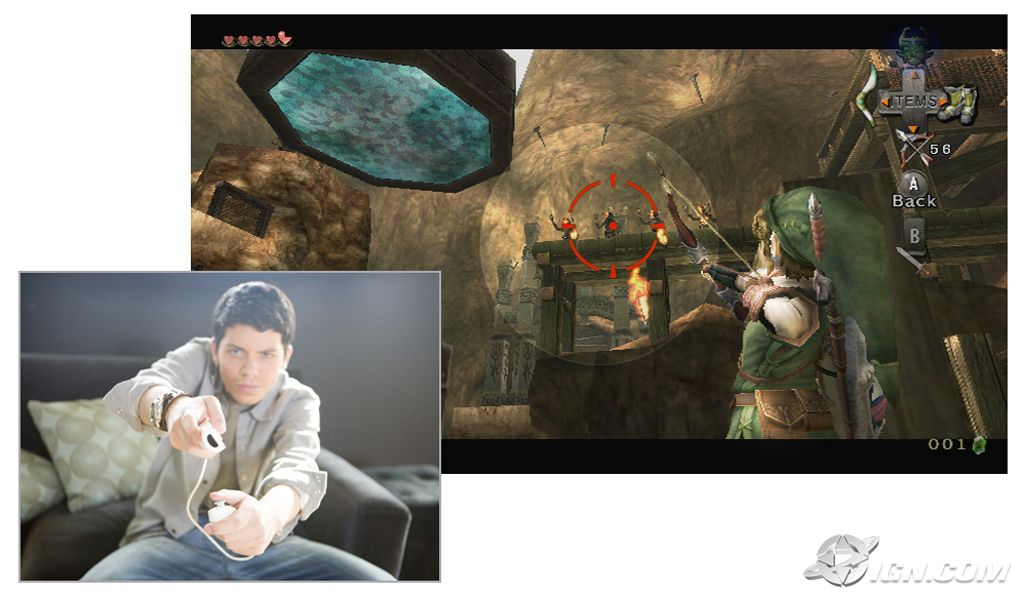
The biggest change in control comes due to the fact that this game is played with a Wii-mote and Nunchuk attachment. The game designers have done an excellent job of transferring the controls to the modified button configuration, while greatly improving control aspects involving targeting, such as shooting a bow or aiming the hookshot. Oh yeah, and and when you swing the Wii-mote or Nunchuck, you swing your sword or shield, respectively. It’s not a 1:1 scheme, which has upset many people, and feels just slightly tacked-on (remember, this was originally a Gamecube game). However, it never detracts at all form the experience, and frequently adds to it.
The combat system has also evolved one step beyond ‘Wind Waker’, which implemented the “Parry” technique into combat. There are now 6 specialty attack techniques, which must be acquired throughout the course of the game. While not a revolutionary step, it’s a very nice addition to an already streamlined combat system.

Difficulty: 8.5
When ‘Wind Waker’ came out for the Gamecube, many people just couldn’t handle the dramatic graphical shift. My biggest complaint, however, with ‘Wind Waker’ was the difficulty of the game. The game had good length, and the puzzles were as mentally challenging as any Zelda game prior. The fighting, however, lacked any real challenge. I think the only time I actually had to continue in the game was when I playfully attacked an animal (I giant pig) until it back lashed enough to kill me; sadly, I wasn’t carrying a fairy in a bottle at the time.
This is a problem that ‘Twilight Princess’, for the most part, rectifies. The action sequences are significantly more challenging, even if a skilled player will rarely be in true danger of dying. The puzzles are also challenging, and fairly fresh. The one thing that seems to really hurt the challenge of the game is the unevenness off the difficulty level. One dungeon can be infinitely more difficult than another, and it has nothing to do with the sequence in which the dungeons are completed. On top of that, the end boss fight, while fairly long and creative, isn’t particularly difficult. As a result, the game ends on a bit of an anti-climax from an action-sense, which is really a shame.

Graphics: 8.0
The graphics in ‘Twilight Princess’ neither lead the gamer to be impressed nor leave him or her greatly disappointed. It’s pretty much a good looking, but not great looking game. No one will confuse it with an XBox360 or PS3 game, and most can easily see the game for the Gamecube port that it is. That being said, it’s a very good-looking Gamecube game. While some are sure to be disappointed by these facts, I never found the graphics distractingly poor, and enjoyed seeing a Zelda game that takes the more “realistic” graphical approach (as opposed to ‘Wind Waker’, which was an enjoyable shift in its own right) in action.

Value: 10.0
I’m a notoriously thorough gamer when it comes to the Zelda series. As a result, I’m quite slow when it comes to beating these games. I like to leave, literally, no stone unturned, no blade of grass uncut, and no pot unbroken. With two very minor side quests not quite completed (don’t worry, I’ll be going back to complete them!), I finished the game after a lengthy 83 hours of gameplay. If anyone can find a single-player game out there that provides that kind of longevity, please let me know what games it is, and if it’s any good!

Legacy: Everybody’s Second Favorite
Is it the best Zelda game ever? That was the hype surrounding the ‘Twilight Princess’ when it was released, and it’s high praise to have to live up to! Keep in mind that numerous publications gave ‘The Legend of Zelda: The Ocarina of Time’ not only a 10.0/10.0 ranking, but touted it as the best video game of all time when it came out for the N64 many years ago. Even those who disagreed couldn’t argue with the fact that many people thought that; it was just an exceptional game.
So where does ‘Twilight Princess’ fit in? Unfortunately, that is an answer I’m not sure I can fully give. The game is excellent. It fits right in the upper tier of all-time video games, just like ‘A Link to the Past’, ‘Ocarina of Time’, and ‘Wind Waker’ (many people would dispute the virtues of this game, but I would argue for it as the 2nd most enjoyable game in the series, after ‘A Link to the Past’, and the numerous Game of the Year awards it won would seem to support that). If I had to guess, when more time has passed and fans of the series can look back at ‘Twilight Princess’ more objectively, I see it become many people’s second favorite, but not many people’s favorite. It does everything well, it just doesn’t stand out in any way. ‘A Link to the Past’ is more fun, ‘Ocarina of Time was more ground-breaking (introducing 3-D graphics/controls, and expanding the scope of all video games to a new level), and ‘Wind Waker’ provided the most unique experience of them all. In the end it has many of the best aspects of the previous Zelda games wrapped into one complete package; it just doesn’t have any elements that it can stand on as its claim to glory all on its own.

Sunday, May 14, 2006

The Race is Over (Before it Even Began)

I’m sure most of you remember one of the great advertising wars of our generation. The battle for dominance in the American brewing industry has had many incarnations, perhaps none of which were as memorable as the one started by Miller with their “President of Beers” campaign. The timing was right (the months leading up to the U.S. Presidential Election), the character was well chosen (the other, non-David Cross guy from ‘Mr. Show’, who also gives a masterful performance as the marriage counselor in ‘Arrested Development’, Season 1), and the script was great.

An unveiled jab at Budweiser’s “The King of Beer” moniker and image, the Miller campaign had many highlights. Shots ranged from the opening ad’s line, “I guess they never got the memo. America is a DEMOCRACY, break it down: ‘Demo… cracy’!”, to the not-so-veiled jabs at George W.’s occasional mixing of words when the President of Beers candidate declares Bud’s actions a “Traveshamockery”. This campaign made it impossible for even the most ardent Budweiser fan to hold back a snicker or two.

And then came the response. First of all, Budweiser routinely blows away all competition with their advertising. Whether it’s the Super Bowl or just run-of-the-mill prime-time programming, their presences is always felt, and their ads are almost always good. Because of this picking a fight with the Budweiser advertising agency probably wasn’t such a good idea (and possible a little bit of a desperate move by Miller). Especially considering the fact that they forgot to take into account one little detail.

“Ladies and gentlemen, the race for President of Beers has come to an abrupt end,” declared the Budweiser Donkey (his introduction to the Budweiser family was another great ad in a string of successful animal promoters). He goes on to describe his discussion with the Budweiser Clydesdales, where he learned that Miller had recently been purchased by South African Breweries. This, of course, makes them ineligible to become President of Beers. And as if these ads weren’t enough, Miller weakly filed a lawsuit against Budweiser, further incriminating themselves as the losers, in a campaign war they themselves had started.

The reason I bring this up is simple. Another race has “come to an abrupt end”. The race to be king (or President, if you will) of the next-generation home video gaming consoles. As you might remember, I wrote an article laying out the race for you all several months back, and I’m not only standing by my predictions that Nintendo’s newly re-christened “Wii” (formerly the ‘Revolution’) will change gaming as we know it, but is going to win the race for dominance in this generation of console gaming.

Why should we care that Nintendo will be the winner, and why are you so confident about this fact, you may ask? First of all, we should care because, well, Nintendo are the good guys. They all but invented video gaming, and they’ve also been the driving force behind innovation for over 20 years. Not only that, Microsoft and Sony (like their fathers before them, aka Sega and Turbo Graphics), are the bad guys. And by that I mean, they just jumped on the bandwagon and hoped that copying and maybe slightly improving things with their system, they could make some extra money. Never mind that in the cases of Sony and Microsoft their strategy basically is limited to using the raw power of resources at their disposal (read: lots and lots of money) to kill all competition: whether they make a profit right now or not. They’re the Wal-Mart of the gaming world: you get in the store, and it’s a nice easy shopping experience, but deep down you know you’re selling your soul (and the souls of every local small business) to save a few bucks. We all do it, but when/if we ever get to the point where money is no longer the only object, we start shopping at Target again…

And secondly, to answer why I am so confident Nintendo will come out on top. Anyone who was at, has read about, or watched any footage from the recent E3 convention must, at the very least, admit that it could turn out that way. Nintendo blew away the competition at E3. Their lines were backed up for as much as 4 hours wait time! They had more games to play than anyone thought possible, considering how short a time it’s been since they finally gave developers a kit to start programming for the new system (although some were merely demos to help people understand and get used to the controller, there were 27 playable games in all). From the latest Zelda game where you can use your off-hand to smash enemies in the mouth with your shield while swinging your sword (as well as literally pulling back the bow-string while aiming a deadly arrow), to ‘Excite Truck’ (sound familiar to the myriad of ‘Excite Bike’ fans out there?), where you hold the controller sideways in both ands and merely manipulate it in space to change directions and set your car up for a smooth landing after a larger-than-life jump, this system will be not only fun, but intuitive to play.

Another reason I’m so confident goes back to the Miller vs. Bud analogy. After the ads proclaiming Miller’s ineligibility for the “race”, Miller weakly filed a lawsuit (and lost). Sony has done the equivalent, by adding “tilt” functionality to their controller at the last minute. It’s clearly a last-ditch effort to damper some of the effect of Nintendo’s unveiling of their gyroscope controller several months back Before you even think this means they’re going to be able to offer the same game play, hold your collective Clydesdale horses. This is NOT the same as what the Nintendo “Wii-mote” has to offer.

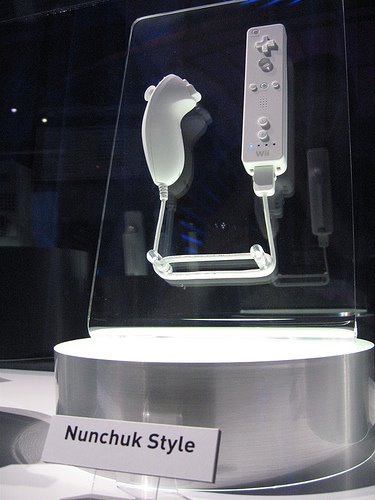
First of all, the Sony controller only offers 6 direction tilting (forward-backward, left-right, and up-down). This is fine and dandy for some things (like flight similar, such as the game ‘Warhawk’ which Sony demoed this feature on), but does not offer near the same game-play options as the Wii’s control. Not only can the Wii-mote sense complete three-dimensional movement (different than tilting in that the system can sense when the controller actually moves in each direction, as well as when it tilts), allowing for complex functional activities such as swinging a tennis racquet, a golf club, or slicing with a sword). On top of that, the analog attachment, which can be plugged into the controller (this one is dubbed the “Nunchuk”) to provide for more game-play elements (allowing movement of a character while aiming with the Wii-mote, for instance), also has motion sensing capabilities. This allows for very integrated game play such as the Zelda example used earlier where the player controls movement with the left (nunchak) hand, while aiming or swinging with the right hand, while also performing accessory movements like blocking or hitting people with the shield.

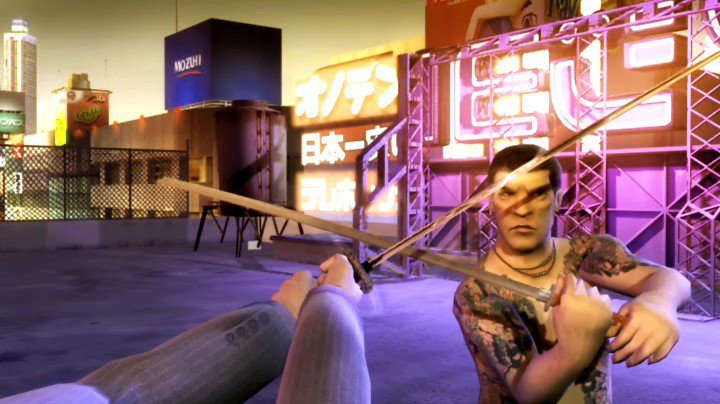
The third and final reason I’m confident enough to guarantee Nintendo’s success is the price-point. The system is expected to debut at around $200, or possibly even less. The PS3, on the other hand, is expected to debut at a price similar to the XBox 360, or between $400-$600. This not only gives Nintendo a distinct advantage for people in the market for one gaming system, but (and possibly more importantly) opens it up to be everybody’s second favorite. Now I’m not saying this is Nintendo’s goal, or what will happen. I’m simply pointing out that anyone in the market to own two systems is more likely to buy the Nintendo Wii as one of those systems for the more diverse games it will bring to the table, as well as the fact that buying not one, but two $600 systems would be more than a little bit cost prohibitive (Pictured above and left, 'Red Steel').

So are you ready for a Revolution? As soon as I heard that ‘Zelda: Twilight Princess’ would be launched simultaneously on the Gamecube and Wii (of course with much added functionality on the Wii) as a launch-day title, I made up my mind that I will pre-order. Call me a Nintendo junkie, call me a blind follower, call me whatever you want. But I’m excited, and I think you gamers everywhere should be too!